PREFIRE
PREFIRE
Polar Radiant Energy in the Far-InfraRed Experiment
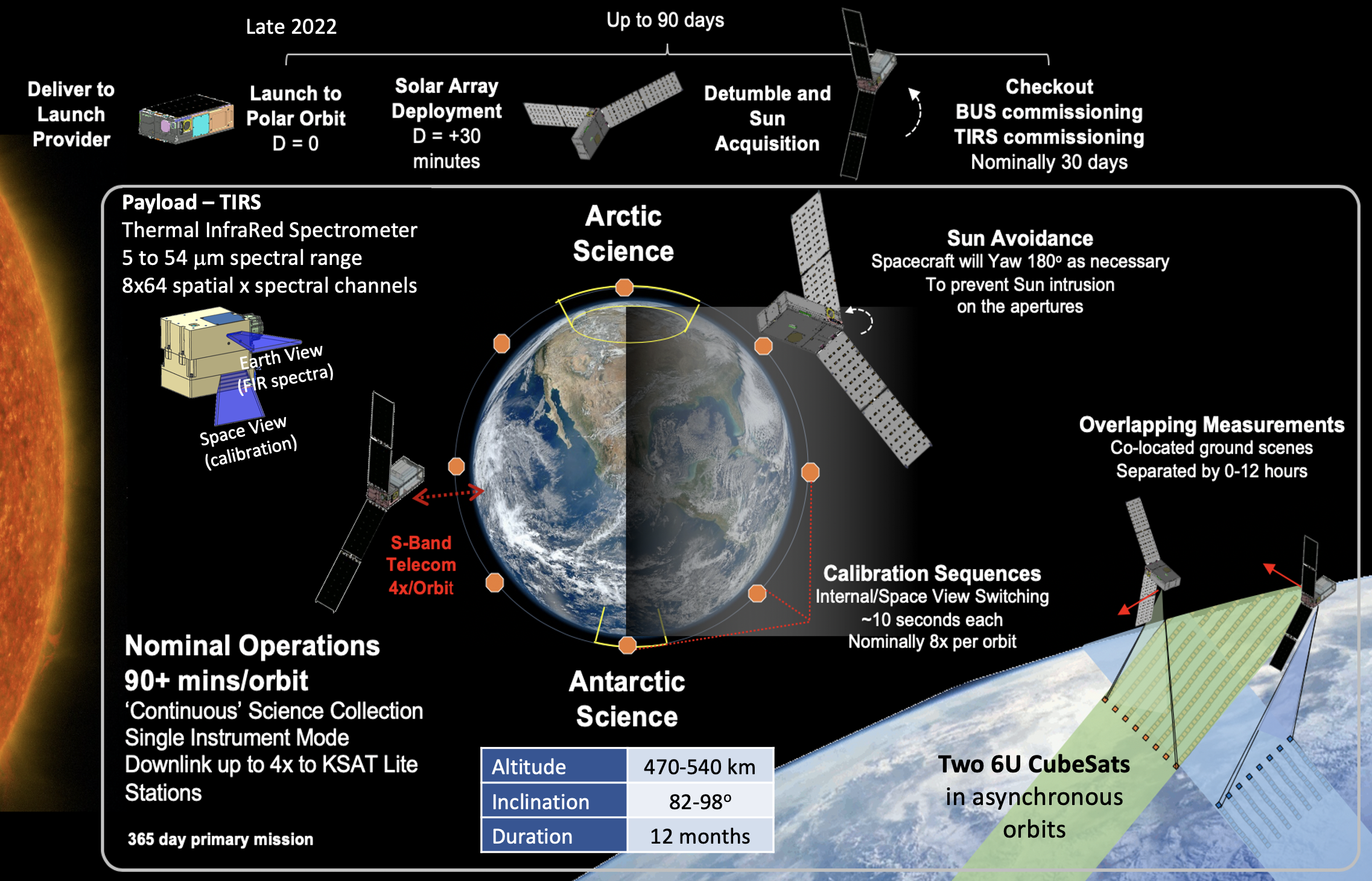
Our group leads the NASA Earth Venture-Instrument (EV-I) Polar Radiant Energy in the Far-InfraRed (PREFIRE) mission. In collaboration with the Jet Propulsion Laboratory, University of Michigan, University of Colorado, and Blue Canyon Technologies, PREFIRE provides the first systematic measurements of the Earth’s far-infrared emission spectrum and utilizes them to understand thermal energy balance in polar regions.
The far-infrared, defined as wavelengths longer than 15 micrometers, accounts for more than 60% of the thermal emission at polar latitudes. PREFIRE measurements enable new insights into the surface emissivity, atmospheric greenhouse effect, and their variability essential for quantitatively modeling the surface/atmosphere interactions and feedbacks at the root of rapid polar climate change. Both CubeSats, launched in 2024, carry thermal infrared spectrometers utilizing a thermopile detector array that operates at ambient temperature will measure spectral radiances from 5-54 microns with 0.84 micron spectral sampling. The instruments quantify the spectral characteristics of the surface, atmospheric water vapor, and clouds and their variability from sub-daily to seasonal timescales across the varied polar regimes encountered over the operational lifetime of one year.
In addition to providing the first climatology of far-infrared emission at both poles, the dual spacecraft measurement capability enables sub-diurnal sampling that allows the far-infrared signatures and impacts of rapid melting and freezing processes to be characterized.